
Heritage manufacturer in the home improvement sector
Finding the gold in what’s already there
I love working with established brands, the ones with years of stories, data and content layered into their websites. Often, there’s gold hiding in that legacy material. You don’t always need to start again; sometimes, the smartest move is to uncover what’s working and focus your energy where it counts.
That was the case for a heritage manufacturing business in the home improvement sector. A previous SEO audit I'd carried out had highlighted just how much content had accumulated on the website over the years. With a redesign on the horizon, I recommended a full website content audit to understand what was still valuable, what needed attention and what didn't need to make the journey to the new site.
The challenge
Over 500 pages of content.
A mix of product information, blogs and case studies.
Years of content, but no clear view of what was still earning its place.
The website had grown organically over many years, with valuable pages hidden among outdated posts and duplicated topics. The business needed to understand what was still relevant, what supported their commercial goals, and what could safely be removed. Without that clarity, any redesign risked carrying years of unnecessary weight into a new build.
The solution
I carried out a full audit of 93 core pages and 433 blog posts, bringing together website performance data with a hands-on review of the content itself. But performance was only part of the picture. I also considered factors such as the importance of each page to the business, who it was for, the intent behind it and whether the content was genuinely doing its job.
To make that assessment more consistent, I developed my own Content Quality Score, a framework for evaluating the quality of individual pages without relying on traffic data alone. This helped distinguish between content that simply wasn't attracting visits and content that was outdated, weak, irrelevant or no longer had a clear reason to exist.
Each page was categorised with practical recommendations: Keep, Update, Review or Remove, along with tailored guidance for key pages to help the client and their web team make informed, data-led decisions about migration, templates and future optimisation.
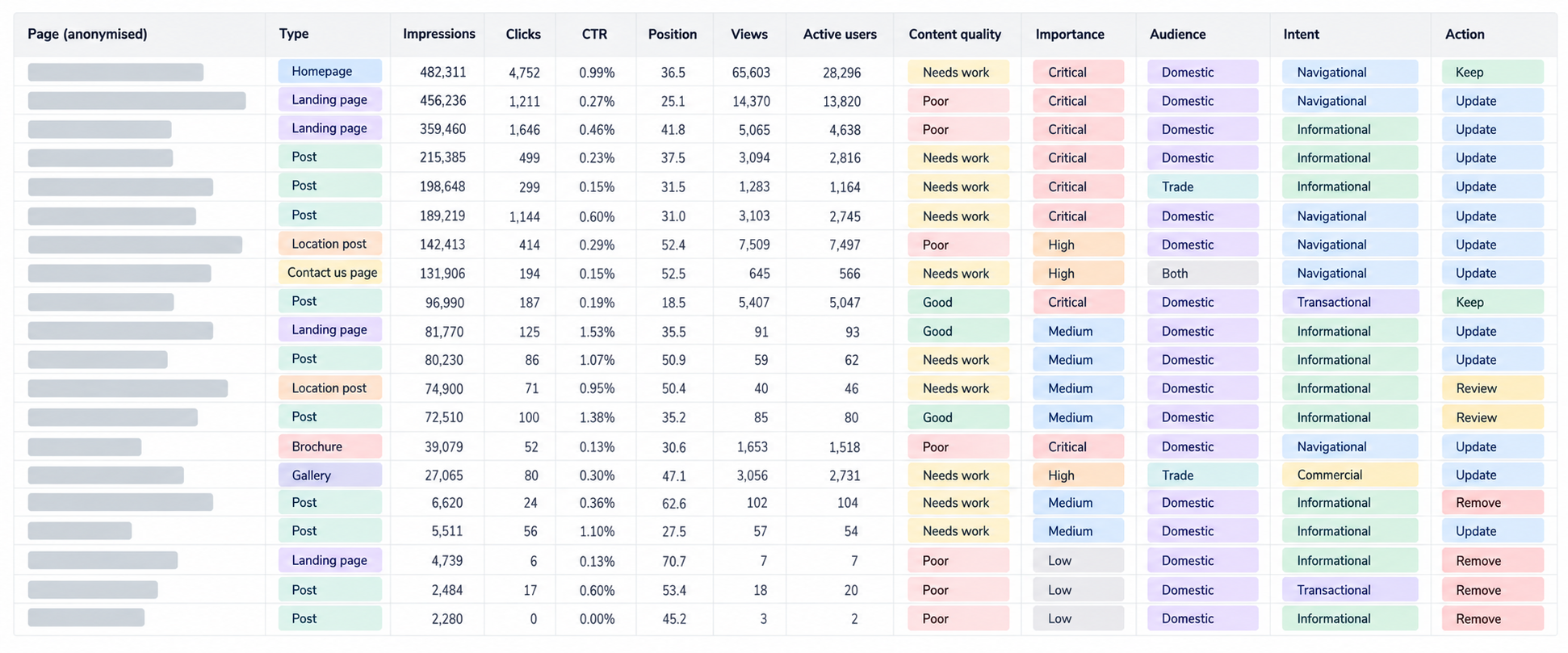
More than 500 pages were assessed against performance data, content quality, business importance, audience and intent, turning a sprawling content estate into a clear set of actions.
And now? Content quality matters even more
The search landscape has changed significantly since this project began.
People aren't only finding businesses through a page of Google results anymore. AI Overviews, AI search and tools such as ChatGPT and Copilot increasingly interpret information from across the web and provide answers directly.
Google says the same fundamental SEO principles still apply to its AI search experiences, including creating helpful, reliable, people-first content. And this is no longer a fringe part of search that sits outside normal measurement: Google Search Console now includes reporting for Generative AI features, giving businesses more visibility into how their content is being surfaced through AI-powered search.
That makes the quality of the content sitting on your website more important, not less.
Years of outdated, overlapping or low-value content don't suddenly become useful because AI has arrived. If anything, there's a stronger case for knowing exactly what you've published, whether it's still accurate, what purpose it serves and whether it genuinely adds something useful.
There's another shift too. Ranking well doesn't guarantee the click it once did. Research from Ahrefs using 300,000 keywords found that the presence of a Google AI Overview correlated with a 58% lower average click-through rate for the top-ranking page.
So the job isn't simply to produce more content in the hope of attracting more search traffic. It's to build a body of useful, current and purposeful information that clearly demonstrates what your business knows and does, wherever your audience happens to encounter it.
Which makes regularly reviewing, updating and, where necessary, removing content less like website housekeeping and much more like good digital strategy.
The results
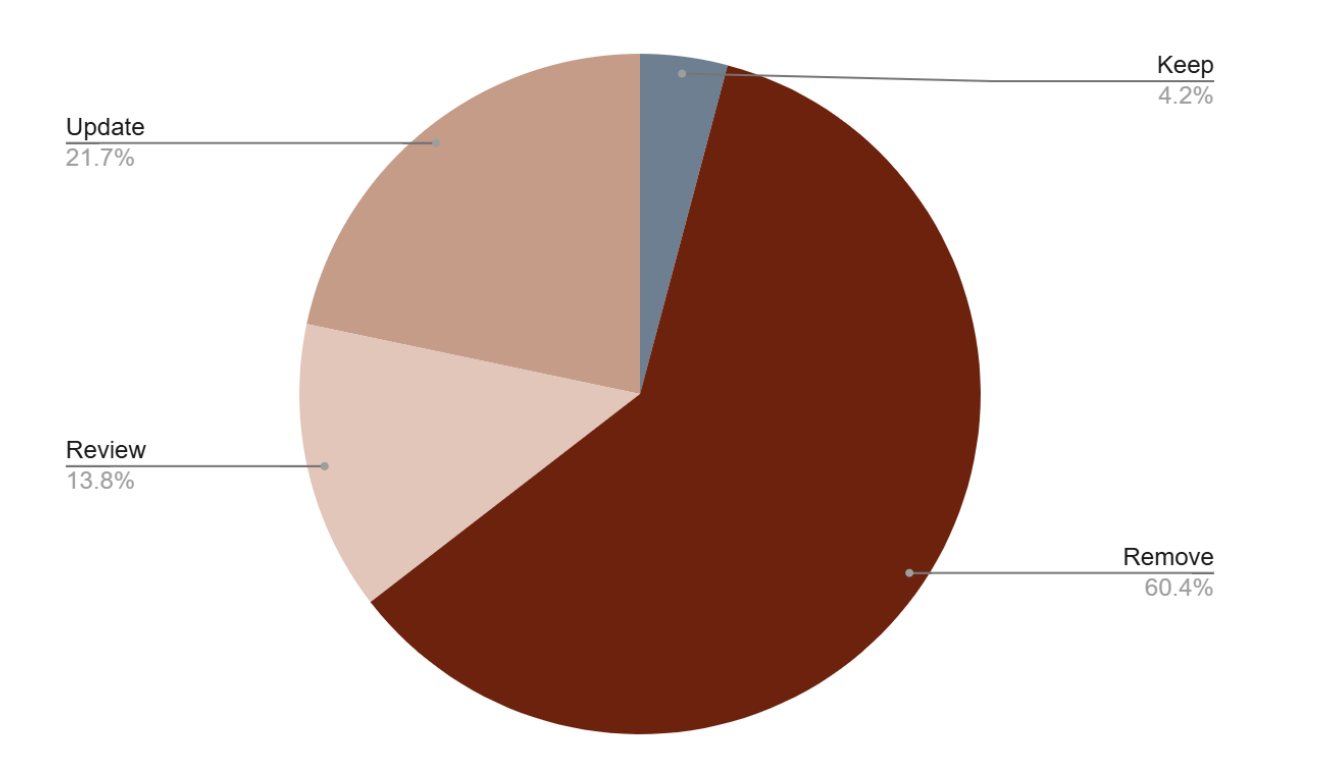
The audit found that 60% of the website's content could be removed, while just 4% was ready to carry forward unchanged.
530 pages assessed in total
60% recommended for removal
22% identified for update
4% suitable to retain as-is
The audit provided an immediate roadmap for the redesign, reducing the content load, clarifying priorities and tightening the web brief. That meant a leaner site structure, fewer templates to design, and cost savings during development.
More importantly, the process gave the client full visibility of their content landscape for the first time. They had a clear view of the role each page should play, what needed attention and what could be left behind.
The audit also created a stronger foundation for future search performance. Google's guidance continues to emphasise useful, reliable, people-first content, rather than creating content primarily to attract search visits.
This project proved that progress doesn’t always mean producing more. Sometimes it’s about sharpening what you already have, so every page exists with purpose and intent.
What’s hiding in your website?
If your website has grown over the years and you’re no longer quite sure what’s working, what needs updating or what shouldn’t be there at all, get in touch to discuss a website content audit.